Essay Map · Cartu Collection
Essay Map — Situational Awareness
Leopold Aschenbrenner's June 2024 essay series, drawn as a ladder that closes into a loop, four open gaps, and one sealed room.
The central argument in five sentences
- 1AI got dramatically better from 2019 to 2023, and it did so on a steady trend, "straight lines on a graph." p. 8
- 2Extend the line four more years and you get an AI that can do an AI researcher's job by 2027. p. 41
- 3Once AI does AI research, you run millions of copies, and progress speeds up on itself: a decade of advances in a year. Superintelligence follows. p. 47–49
- 4Something that powerful is a weapon, and a weapon arriving that fast creates four emergencies: the electricity to build it, keeping it from being stolen, keeping control of it, and staying ahead of China. p. 75–140
- 5Every one of those emergencies ends at the same door. The US government takes over the effort, by 2027 or 2028. p. 141–154
"But once models can automate AI research itself, that's enough—enough to kick off intense feedback loops—and we could very quickly make further progress, the automated AI engineers themselves solving all the remaining bottlenecks to fully automating everything." p. 41
T's reading · The milestone · Where are we as of September 2026
The automated AI researcher
The day an AI can hold the whole job, the ladder starts climbing itself and we enter the loop.
The job, in his words: "read ML literature and come up with new questions or ideas, implement experiments to test those ideas, interpret the results, and repeat." The milestone is an AI that does all four steps on its own, including the first one, deciding what to try. Three unlocks get there: onboarding, long-horizon work, and using a computer. Everything after Chapter II assumes this day has come. p. 34–37, 41, 49
The three stages he lays out
| Stage | His date | What it looks like |
|---|---|---|
| Proto-automated engineer | 2026/27 | Does much of the engineering, has blind spots, speeds up work 1.5–2x. ← September 2026 sits here. |
| Proto-automated researcher | 2027/28 | Automates more than 90% of the job; humans still a bottleneck; 3x+ speedup. |
| Full automation | 2028/29 | 10x+ pace of progress; superintelligence follows. |
Stages and dates from p. 63.
Where the evidence puts us
- Anthropic, May 2026. More than 80% of the code merged into its own codebase is written by Claude, and engineers produce about four times as much with its latest model.
- OpenAI, September 6, 2026. "We have now reached the goal, announced last fall, of having an automated research intern by September of this year. By 'research intern,' we mean a system that can carry out well-defined research tasks under human direction, including tasks that would take a skilled researcher a few days. We are making strong progress toward creating an automated AI researcher by March of 2028."
- The Institute for Progress reports that leadership statements from both OpenAI and Anthropic point to full automation of AI research by 2028.
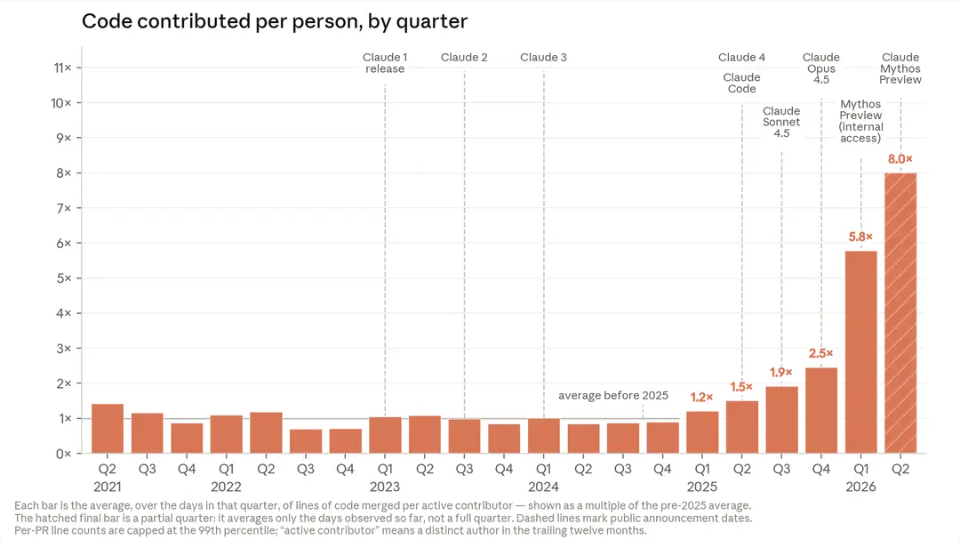
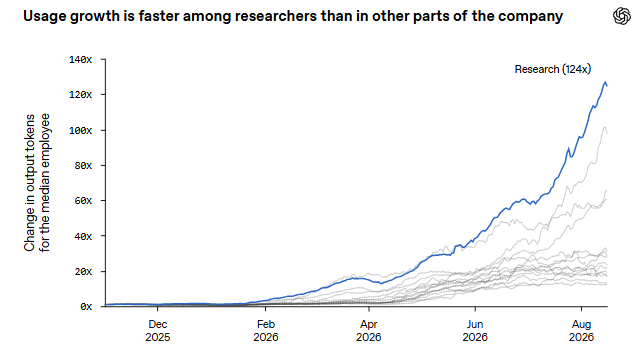
Figures reproduced from the two companies' own reports for commentary, with links to the originals.
Reading. We are at his first stage, the proto-automated engineer, roughly on his schedule for it. The loop has not closed.
Sources. Anthropic, When AI builds itself (May 2026) · OpenAI, Research acceleration: the view inside OpenAI (September 6, 2026) · Institute for Progress, How should the US prepare for increasingly automated AI R&D? (August 2026)
For context
The words
An order of magnitude, an OOM, is to think on the scale of the powers of 10.
10x
100x
1,000x
10,000x
100,000x
- Effective compute
- Raw computing power times how well the software uses it. Two ways to get 10x: buy ten times the chips, or find a trick that makes the same chips ten times more useful.
- Unhobbling
- Taking off the handcuffs. Remove a limit and you unlock ability that was already there.
- The data wall
- The internet is finite, and models have read nearly all of it, if not all of it, multiple times.
- AGI
- "These AI systems will basically be able to automate basically all cognitive jobs (think: all jobs that could be done remotely)." p. 41
- Superintelligence
- "AI systems vastly smarter than humans, capable of novel, creative, complicated behavior we couldn't even begin to understand—perhaps even a small civilization of billions of them. Their power would be vast, too." p. 48
- Model weights
- A finished AI "is just a large file of numbers on a server." p. 93
- Algorithmic secrets
- The recipe for making the file.
- Superalignment
- Staying in control of something smarter than you.
- The Project
- A government-run AGI effort, on the model of the Manhattan Project.
I · The ladder
Count the zeros
In the essay: From GPT-4 to AGI: Counting the OOMs
Every 100,000x of effective compute, one big jump in ability.
In plain words. The jump from GPT-2 (2019), which wrote like a preschooler, to GPT-4 (2023), which tested like a smart high schooler, took about 100,000x more effective compute. He counts another 100,000x by 2027, so he expects another jump that size: from smart high schooler to something that can do expert work. p. 9, 38
Where the zeros come from
- Bigger computers. About half a zero per year. Money drives it, well beyond what Moore's law would give. "Spending even a million dollars on a single model used to be an outrageous thought nobody would entertain, and now that's pocket change!"p. 20
- Better algorithms. Another half a zero per year. Same chips, better tricks. One example: the cost of getting a model to solve competition math dropped about 1,000x in under two years.p. 22
- Less restraint / unhobbling. The step changes. Let it think before answering. Give it tools. Give it memory. The next three unlocks he names: onboard it like "a smart new hire that just showed up 5 minutes ago," let it work on a problem for weeks instead of minutes, and let it use a computer the way a person does.p. 34–37
The picture he offers. AI progress runs at "roughly 3x the pace of child development. Your 3x-speed-child just graduated high school; it'll be taking your job before you know it!" p. 40
The number to remember. 100,000x by 2027. p. 9
Where it could break. The data wall. If the labs cannot teach models to learn more from less data, progress stalls and "we are stuck with merely expert chatbots, rather than expert coworkers." He bets they will crack it, the way AlphaGo went beyond copying humans by playing itself. p. 29, 41
II · The loop
The AI does the research
In the essay: From AGI to Superintelligence: the Intelligence Explosion
Run a hundred million copies, and a decade of progress takes a year.
In plain words. An AI researcher's job happens entirely on a computer: read papers, have ideas, run experiments, look at the results, repeat. Once an AI can do that job, you do not hire one. You run many millions of them, "perhaps 100 million human-equivalents, and soon after at 10x+ human speed," day and night. The progress that took humans a decade takes them a year. He calls the result superintelligence, and he thinks it could arrive within about a year of AGI. p. 47–49, 56
What could slow it down, and why he thinks it won't be enough
- Experiments need computer time, and there is only so much.The counter argument: the AIs run smarter experiments, at least 10x more efficiently. p. 53
- The last 10% of the job may be hard to automate. The counter argument: a couple of years of delay. Superintelligence by 2028/29 instead of 2028. p. 54, 63
- Algorithmic progress may have limits. The counter argument: 5 more zeros is achievable, while 25 more is out of reach. p. 54
- Ideas get harder to find. The counter argument: a million times more researchers overwhelms that. p. 55
What superintelligence could do. Solve robotics. Compress a century of science into a decade. Grow the economy 30% a year. Hand whoever holds it a decisive military edge. Even "overthrow the US government." p. 68–70
The picture he offers. "We'll be like high-schoolers stuck on Newtonian physics [the humans] while it [superintelligence] is off exploring quantum mechanics." p. 67
III · The funnel
Four open gaps
In the essay: The Challenges
Something that powerful, arriving that fast, needs four things the world does not have yet.
He says the first is already being built. The other three are behind. p. 75
IIIa. The electricity · the engine
Each new model needs a bigger computer. On the current trend: a computer costing more than $1 trillion by 2030, drawing about 100 gigawatts, "more than 20% of US electricity production." For scale, he puts 1 gigawatt at "the Hoover Dam, or a large nuclear reactor." So: a hundred Hoover Dams for one computer. p. 76–78
The scarce thing is electricity, not chips. US power generation grew about 5% in a decade. His answer: natural gas, deregulation, and build it in America rather than the Gulf. p. 83–88
IIIb. The theft · the recipe
A finished AI is one file. Steal it and you skip the trillion dollars. The recipe for making it is being invented right now, and he says it is protected like a startup's, "the way we would random SaaS software." His line: "Currently, they're basically handing the key secrets for AGI to the CCP [Chinese Communist Party] on a silver platter." His fix is government-grade security: secure rooms, clearances, computers cut off from the internet. His verdict: "Basically nothing else we do—on national competition, and on AI safety—will matter if we don't fix this, soon." p. 89–90, 103
IIIc. The controls · staying in charge
Today we train AI by human thumbs-up and thumbs-down. That works only while a human can judge the answer. When the AI writes a million lines of code in a language it invented, nobody can grade it. During the loop we go from "we can check its work" to "we cannot" in under a year, and from "mistakes are harmless" to "mistakes are catastrophic." His plan: use the somewhat-smarter AIs to help check the smarter ones, build lie detectors from the model's insides, keep it in a sealed box, and refuse to rush. His mood, in two lines: "I am not a doomer" and "We're counting way too much on luck here." p. 105, 108, 113–125
IIId. The lead · breathing room
Superintelligence would compress "the military technological advances of a century" into less than a decade, so a lead of a year or two would be decisive. China can catch up two ways: build more power plants, and steal the recipe. A treaty will not hold, because cheating pays too well. The safe path in his view: the democracies keep a two-year lead and spend it on safety when they need to. "A 2 year vs. a 2 month lead could easily make all the difference." p. 129, 131, 137–138
IV · The room
The Project, one door
In the essay: The Project
Why he thinks the government takes over, and when.
In plain words. This is a prediction, not a wish. Once it is obvious that superintelligence is a weapon, the government will not leave it to a startup. "Imagine if we had developed atomic bombs by letting Uber just improvise." By 2027 or 2028: the leading labs merge into a national effort, the top researchers move to a secure site, Congress funds it. p. 141–145
Why he thinks only the government can do it. Security, which only a state can provide. A sane chain of command: "Imagine if Elon Musk had final command of the nuclear arsenal." Safety decisions made in a fog of war. And holding the world together afterward. p. 147–152
His warning. "The Project is inevitable; whether it's good is not." The open questions are when, with which allies, and whether it is run competently. "This is the ballgame." p. 152–154
The endgame, in his words. "And so by 27/28, the endgame will be on. By 28/29 the intelligence explosion will be underway; by 2030, we will have summoned superintelligence, in all its power and might." p. 154
Whoever runs The Project has to do all of this at once:
- Build AGI, and build it fast.
- Put the American economy on a wartime footing to make hundreds of millions of GPUs.
- Lock it all down, weed out the spies, and hold off the CCP.
- Manage a hundred million AGIs doing AI research, a decade's progress in a year.
- Keep it from going off the rails into a rogue superintelligence.
- Use those superintelligences to stay ahead of adversaries and remake US forces.
- All while navigating "the tensest international situation ever seen."
"They better be good, I'll say that." p. 154
V · The last word
"What if we're right?"
In the essay: Parting Thoughts
How to hold all this in your head.
Three tenets he calls AGI Realism: p. 157
- "Superintelligence is a matter of national security."p. 157
- "America must lead."p. 158
- "We need to not screw it up."p. 158
His closing. A few hundred people see this coming, and "there is no crack team coming to handle this." p. 159